
New or Existing Industrial Hall? Advantages and Disadvantages in 2026
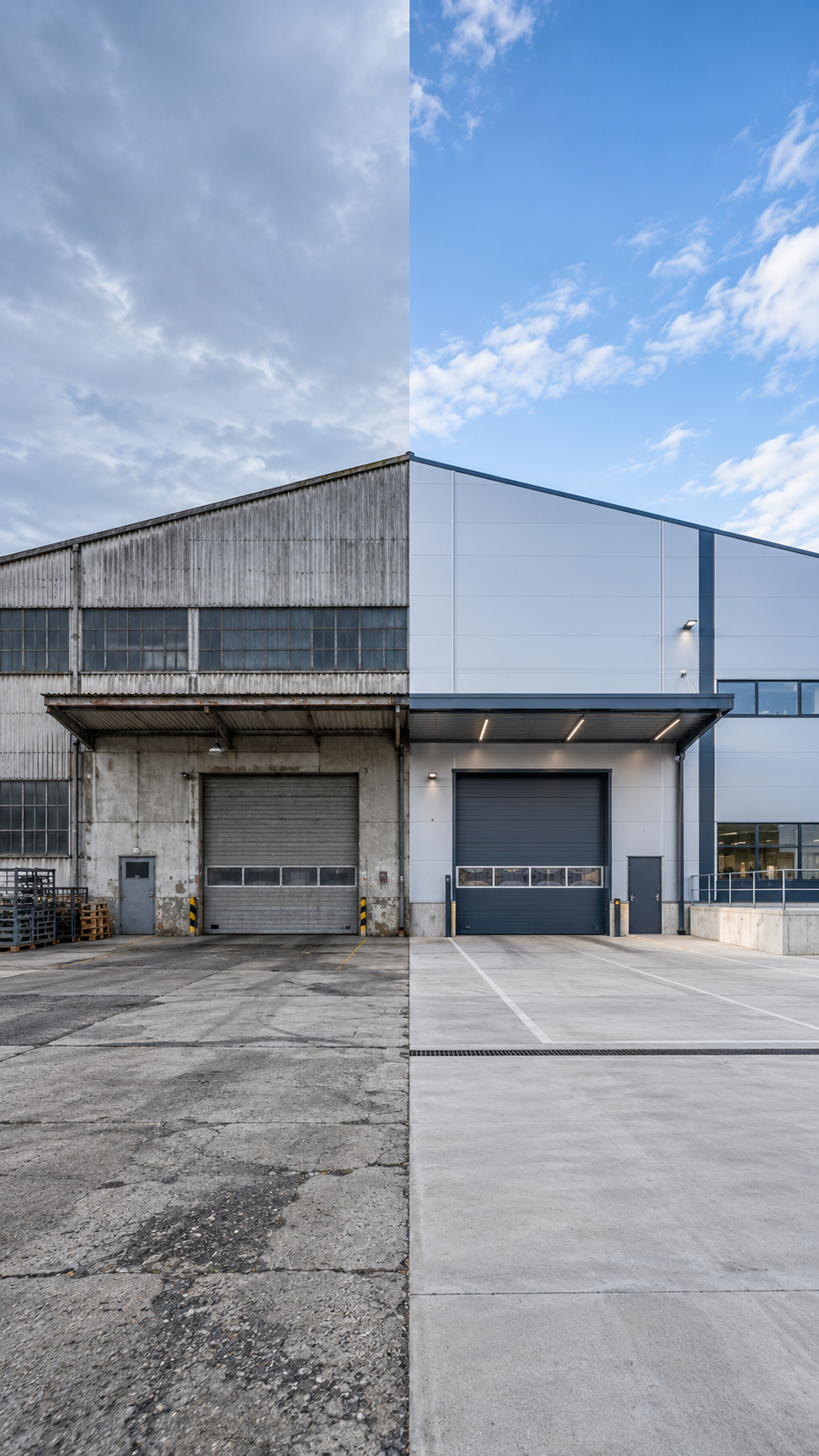
New or Existing Industrial Hall? Advantages and Disadvantages in 2026
Is it better to build a new industrial hall or purchase and modernize an existing one?
The decision should not be based solely on price. It should consider the total investment cost, implementation time, operating expenses and the property’s future value.
New industrial hall – advantages
The main advantage is that the building can be designed specifically for your business—from its dimensions, access and internal layout to technical installations, energy efficiency and future expansion possibilities.
A new building involves fewer technical risks, offers better control over operating costs and can meet current standards from day one. If it is well located and efficiently designed, it may also achieve a higher rental or resale value.
New industrial hall – disadvantages
The main disadvantage is the higher initial investment.
In 2026, indicative construction costs may start at approximately €200–€350 per square metre for simple buildings and reach €300–€450 per square metre for a standard turnkey industrial hall. Production facilities and complex projects can cost considerably more.
Additional expenses may include the land, design, permits, external platforms, utility connections and interior fit-out. A new development also requires more time before it can become operational.
Modernized existing hall – advantages
The main advantage is that a significant part of the investment already exists: the land, building, foundations, access roads, platforms and utilities.
In some cases, the property may also benefit from a high installed electrical capacity, which can be difficult and expensive to obtain for a new development.
Location can be another decisive advantage. An existing hall in an established industrial area may be more valuable than a new building in a location with inadequate access or infrastructure.
If the structure is sound and the premises can be adapted easily, modernization may be faster and highly profitable.
Modernized existing hall – disadvantages
A property that initially appears inexpensive may conceal significant costs. Work may be required on the roof, structure, flooring, electrical installations, fire safety systems, insulation, industrial doors or façade.
The building may also have limitations related to height, access, layout or electrical capacity. A technical inspection and realistic modernization estimate are therefore essential before purchase.
There is little benefit in saving €200,000 on the purchase price only to discover later that another €250,000 is required for structural reinforcement and repairs.
Comparative example
Consider an industrial hall of approximately 4,000 square metres.
Constructing a new facility may require an indicative budget of €1.4–€1.8 million. The land, external platforms, utility connections, design, permits and activity-specific fit-out may need to be added to this amount.
An existing hall might be purchased, for example, for €850,000. If modernization of the structure, roof, flooring, technical installations and fire safety systems, together with a contingency reserve, costs another €500,000, the total investment reaches €1.35 million.
In this situation, the difference compared with a new building becomes much smaller than it first appeared. The investor must determine whether the savings justify the technical limitations and risks associated with an existing property.
When is modernization worthwhile?
Modernization may be the right choice when the property has a good location, a sound structure, sufficient utilities and can be adapted without major interventions.
As a general guideline, the total cost—including acquisition, modernization and a contingency reserve—should remain at least 20–25% below the cost of a comparable new industrial hall.
When is it better to build new?
A new development is generally more suitable when the existing hall has structural problems, outdated installations or does not meet the operational requirements in terms of height, access, configuration or technical specifications.
It is also justified when energy efficiency, a modern image or long-term use over the next 20–30 years are important objectives.
Verdict
If the difference between a modernized existing hall and a new one is only 10–20%, the project should be analysed very carefully. Unexpected costs can quickly eliminate the initial savings.
If modernization brings the investment close to the cost of a new building, it may be more logical to construct a facility designed specifically for the intended activity.
In conclusion, the price per square metre should not be the only consideration. The analysis should include the total cost, location, structural condition, functionality, time to operation, maintenance costs and future value.
In real estate, we do not simply buy square metres. We buy potential—and that potential must be calculated in numbers.
At Gaminvest, we analyse industrial opportunities ranging from existing halls with modernization potential to new developments. If you are considering such an investment, we can evaluate it together.